Home / Thirty changes / One part of the shape changed / The heel of Puglia
One person instead of two
Eight nights with the second seat empty, which is what it is to book a solo trip to Puglia in shoulder season
The second traveller is gone and nothing else moves. Eight nights, one base, a hire car, two hours from the airport at Brindisi, shoulder season. What changes is the arithmetic and the driving: to book a solo trip to Puglia in shoulder season is to pay $2,740 rather than $2,340, and to have nobody in the passenger seat reading the junction.
| What it breaks | one person instead of two |
|---|---|
| Nights | 8 instead of 8 |
| Places you sleep | 1 |
| Car | a hire car, as the shape has it |
| From where you land | 2 hours |
| Season | shoulder |
| People the figure is built on | 1 |
| How far from the shape | one part changed |
| Two sharing pay | from $2,740 |
What the second traveller was carrying
One person, not two. Everything else in the house shape holds: eight nights, one base you unpack into once, a hire car, a drive of about two hours from where you land, shoulder season. Taking the second traveller out does not take out half the cost, because almost nothing here is priced by the head. A room in a converted farmhouse is priced for the room. The car is priced for the car, and the second name on the rental was never the expensive part of it. On the Ionian coast an umbrella at a beach club comes with two loungers whether one body uses them or two. So the figure moves from $2,340 to $2,740. Four hundred dollars, and it is not a charge for being alone; it is the share nobody else is carrying. What can be done about that is narrow, and worth saying plainly. Some places keep true single rooms instead of pricing a double down for one occupant. A base inside a town leaves the car parked on three of the eight days. Neither is dramatic on its own. Between them they account for most of the four hundred, and both have to be settled before anything is held.
Forty kilometres of limestone between two seas
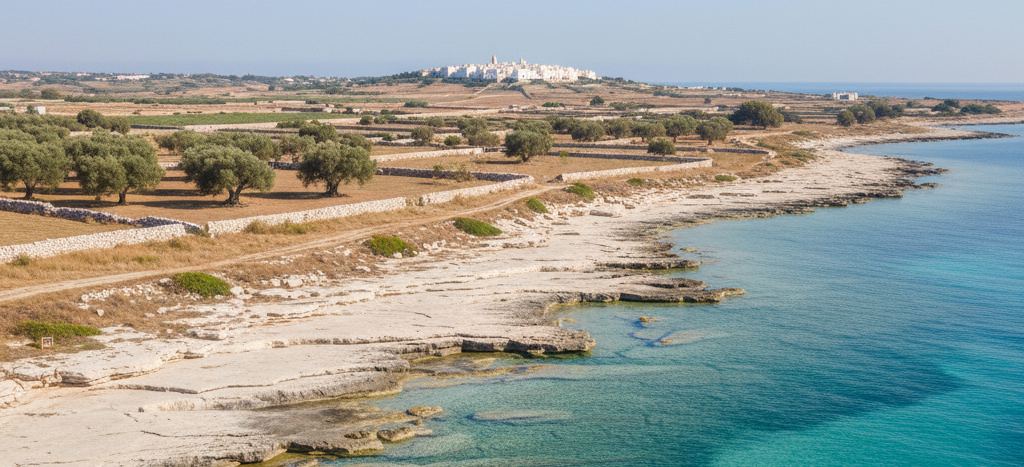
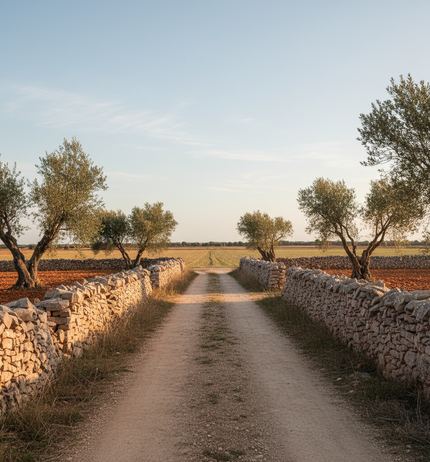
The heel is a limestone shelf about forty kilometres across at its widest, flat enough that you watch weather arrive an hour before it does. Red brown soil sits in pockets on the rock, and the field walls are stacked stone without mortar, hip high, standing right at the edge of the lane with no verge behind them. Both coasts fit into one morning. The Adriatic side is rock: pale shelves stepping down into water you enter by ladder. The Ionian side, thirty to forty minutes west, is sand. Wind decides which one you get. A north wind puts chop on the Adriatic and leaves the Ionian flat, and the correction costs half an hour of driving rather than a day. Distances are short and the roads are slow. Brindisi to Lecce is forty kilometres in about forty minutes. Lecce to Otranto is another forty five, closer to an hour. Santa Maria di Leuca at the point is a hundred kilometres out and an hour and three quarters back, because the road south has been half rebuilt for years. One thing to know before you see it. A bacterium carried by a sap sucking insect has been killing the olive trees here since 2013, and south of Lecce whole fields stand dead and grey with young resistant stock going in between them. It is a working landscape in a bad decade, not a postcard.
One base, one driver
Two hours from where you land covers all of it, so the choice of base is not about reach. It is about what happens at nine in the evening. A flat inside the walls at Lecce means dinner on foot and the car left standing on the days you do not want it. A converted farmhouse in the country means quiet, a long view, and a drive back after dinner on unlit roads where the side turnings cross the traffic rather than join it. With nobody else on the rental paperwork, that drive is yours every night, and one glass is the practical limit. The centre of Lecce is a restricted zone with cameras on the entries. Nothing stops you at the time. The notice reaches the hire company months later, they pass it on with a charge for the trouble of doing so, and by then you have forgotten the street. Park outside the ring and walk in; it is ten minutes. Blue lines are paid, white are free, yellow are for residents, and the machine may want coins. Fuel stations outside the towns go unattended after eight in the evening and take cards at the pump, though some refuse a foreign card. Keep the tank above a quarter. The emergency number is 112 and the operators work in English.
What eight days actually contain
The useful hours are early. Shops shut around one and reopen near half past four; churches often close at half past twelve and come back at four. That shapes a day more than distance does. A town in the morning, a swim and a long lunch through the flat part of the afternoon, then a second town at six when the streets refill. There is a great deal of specific work to look at. The cathedral at Otranto has a mosaic floor laid in the 1160s across the whole nave, months and beasts and one enormous branching tree, worn thin where feet have crossed it for eight hundred years. A side chapel holds the bones of the townspeople killed in 1480, stacked behind glass, which is not a gentle sight and is not presented as one. At Galatina a fourteenth century church is frescoed from floor to vault. Lecce is carved out of a stone soft enough to cut like cheese and hard enough to hold the cut. Swimming is the other half of the day. Near the coast road north of Otranto a flooded sinkhole fills through an arch from the sea; access is controlled in season now, so it is a morning slot arranged in advance rather than a stop. Eating alone is unremarkable in Lecce and slightly conspicuous in a marina village in October, when the one open kitchen has four tables occupied. Dinner does not begin before eight.
Two windows, and what closes in them
Late April to early June, and the second half of September through October. They are not the same holiday. In May the air runs 23 to 25 by mid afternoon and the sea sits around 19, which is swimmable for perhaps twenty minutes and honest to call cold. In October the air is a degree or two lower and the sea holds 22 or 23, because it spends the summer heating a shallow shelf and gives it back slowly. If swimming matters to you, October is the window with the warmer water. October also brings the rain. The month collects something like eighty millimetres and it does not spread out politely; it arrives in two or three afternoons of proper weather with thunder standing off the water, and the days between are clear. A southerly brings warm wet air and a haze that flattens the light. The northerly that follows scrubs it clean and puts the far coast back on the horizon. The clocks go back on the last Sunday of October and the light is gone by five, which shortens the second town of the day. Beach clubs fold their umbrellas around the middle of the month. Coastal villages close their kitchens for the winter within a fortnight of that. Lecce, Otranto and the larger inland towns stay open and busy all year.
Who this suits, and who it does not
This suits a person who drives without complaint, who likes a place more on the fourth day than on the first, and who is content at a table for one in a room where everyone else arrived in pairs. It suits someone with a project: a camera, a list of churches, a language they are trying to get back. Eight nights in one base means the second half is where the holiday actually happens, once you know which bakery opens at seven and which lane avoids the town. It does not suit a person who wanted company and is going anyway. There is very little enforced sociability here. The small towns are friendly and busy, but busy with families, and an October evening on the coast is quiet in a way that reads as empty if you did not choose to be alone. It does not suit anyone unwilling to drive at night on unlit roads. It does not suit a traveller who needs the day decided for them, because what is handed over is a base, a car and a set of opening hours, not a schedule with somebody at the front of it. If the arithmetic is the problem rather than the solitude, say so when you write. Two people in the house shape is a different page and a different figure.
Awkward questions about this change
- Can the single supplement be taken off?
- No. It is not something this office adds, so it is not something this office can remove. The room costs what the room costs and the car costs what the car costs; with one person using both, one person carries both. The only real lever is timing. The same room in the last week of September and in the second week of October are different money, and the weather between those two weeks changes by very little. Ask for the figure on both and decide with the two numbers side by side.
- Could this be done on the trains instead of the hire car?
- Partly, and not the part most people come for. A regional line runs out of Lecce to Otranto and to Gallipoli, and the main line north serves Brindisi and Bari. Service thins on Sundays and stops early in the evening, and none of it reaches the coast road, the inland villages or a farmhouse standing in a field. Without a car the base has to move into Lecce and the eight nights become a town stay with two day excursions. That is a real holiday. It is not this one, and the figure changes.
- A fine from Lecce arrived four months after I got home. Is that normal?
- Yes, and it usually arrives twice. First the hire company writes to say it has given the police your details, charging you for the administrative work of doing so; then the notice itself comes from the municipality. Cameras on the entries to the historic centre photograph the plate and nothing tells you at the time. Pay through the route printed on the notice and not through anyone who offers to handle it for a fee. Parking outside the ring and walking in avoids the whole thing.
- Who takes my money, and when?
- Not this office. Nothing is charged here and no card number is written down here at any stage. You settle with the people whose bed and whose car you are using, on their terms and at their counters, and their deposit rules are stated to you before you agree to anything. This office is paid afterwards by those suppliers out of their own margin. Your own flights are yours to hold: no carriage by air or by sea is arranged here, and there is no contract with any carrier.
- Eight nights alone in one base. Will I run out?
- Most people do not run out of things to look at; they run out of appetite for the car. The heel is small enough that eight days can cover it twice over, and the usual rhythm is five driving days and three that start on foot: a market morning, a long lunch, an afternoon on one stretch of rock. If you already suspect that a fourth consecutive church will not hold you, say so at the quote stage and the base moves to the coast, where the days can be shorter and wetter.
Others that move the shape about as far
There is no package on this site that somebody has not already asked for, and the thirty in the book are the requests that came back more than once.
-
The Umbrian hill country
Italy · twelve nights instead of eight
from $2,890 two sharing one part changed -
The Burren and south Connemara
Ireland · a driver instead of a hire car
from $3,140 two sharing one part changed -
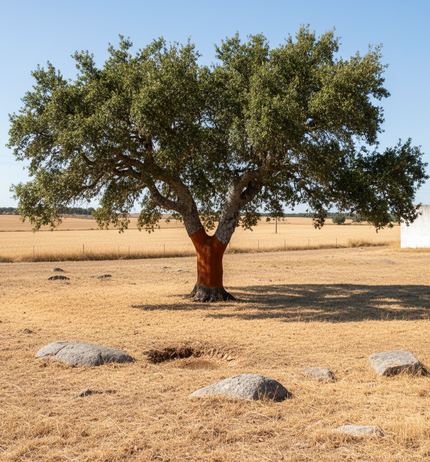
The Alentejo plain
Portugal · five nights instead of eight
from $1,690 two sharing one part changed -
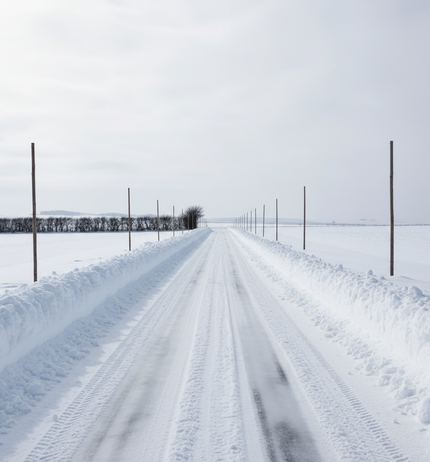
The Jura plateau
France · deep winter instead of shoulder season
from $2,410 two sharing one part changed -
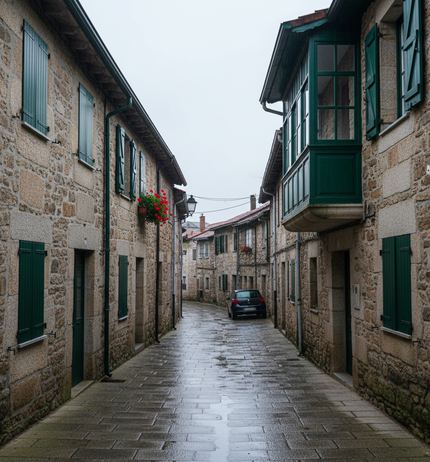
The Asturian coast road
Spain · four of you instead of two
from $2,180 two sharing one part changed -
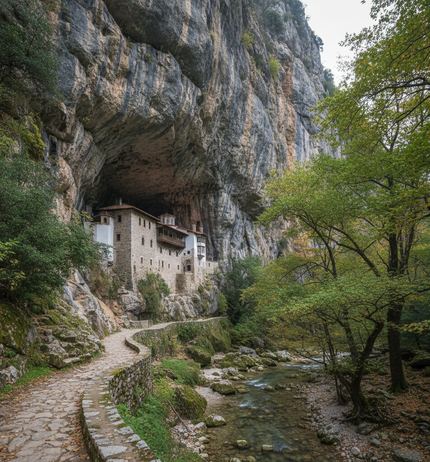
Inland Arcadia
Greece · four hours from the airport, not two
from $2,260 two sharing one part changed -
The Welsh Marches
Wales · high summer instead of shoulder season
from $2,520 two sharing one part changed -
The Aveyron causses
France · sixteen nights instead of eight
from $3,880 two sharing one part changed -
Eastern Slovenia and the Prekmurje
Slovenia · no car at all, trains and a bicycle
from $2,050 two sharing one part changed
Ask for this change in writing
Not a cent moves through here. The supplier bills you under its own name, and what this office earns reaches it from that supplier weeks later.