Home / Thirty changes / Two or three parts changed / Kerry and the Dingle peninsula
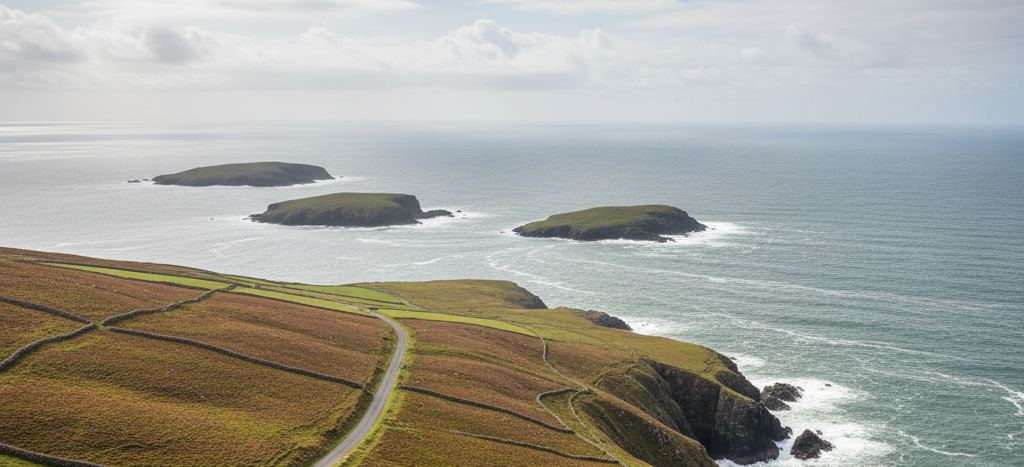
Where the single base splits in two
Two bases instead of one and five of you in the car, so reserve a two base trip to Kerry and Dingle
Three named parts of the house shape give way at once here. The single base becomes two, shoulder season becomes July, and two people become five. Reserve a two base trip to Kerry and Dingle and what you are paying for is nine nights, a changeover in the middle of one of them, and two peninsulas carrying most of their year in six weeks.
| What it breaks | two bases, high summer, five of you |
|---|---|
| Nights | 9 instead of 8 |
| Places you sleep | 2 |
| Car | a hire car, as the shape has it |
| From where you land | 2 hours |
| Season | summer |
| People the figure is built on | 5 |
| How far from the shape | two or three parts changed |
| Two sharing pay | from $3,480 |
What breaks here, and what stands in for it
Three named parts go at once, which is more than most entries in this book ask of the shape. The single base you unpack into becomes two: five nights on the Iveragh side, four in or beside Dingle town. Shoulder season becomes July. Two people become five. Two lines hold, and they are the load bearing ones. The hire car stays, because on these two peninsulas nothing you want to see is reachable any other way at the hours you would want it. And two hours from where you land still holds: Cork and Shannon both sit between ninety minutes and two hours from Killarney on motorway and N road, so the first afternoon is not spent in the driving seat. The figure moves for reasons you can follow to the end. Five people do not fit in one room, so all nine nights are two rooms rather than one, every night, with no version of the week in which that stops being true. July is not a supplement bolted onto a quiet season rate in this part of Ireland; July is the rate. And five people with luggage need a vehicle a size up, which costs more to hire and more to fill. Those three account for the step from $2,340 to $3,480 per person. The ninth night is the smallest line in the difference, not the largest.
Ground: sandstone ridges and drystone walls
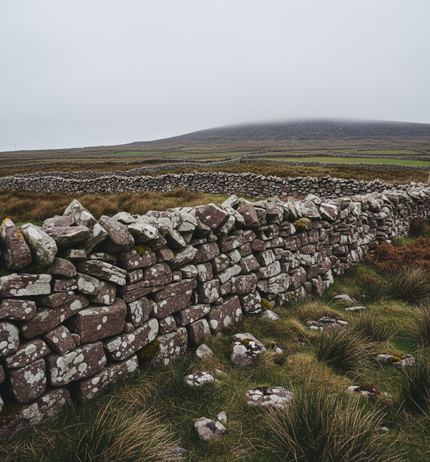
Iveragh and Corca Dhuibhne are two long sandstone fingers pointing west into the Atlantic with Dingle Bay between them, and both are built the same way: a spine of rock down the middle, ice cut valleys hanging off it, a thin skirt of farmed land at the water. Carrauntoohil, at 1,038 metres, stands on the Iveragh spine; Mount Brandon, at 952 metres, on the Dingle one. Neither is far from a road and neither is gentle. The skirt is where the days are actually spent. Fields there are small and walled without mortar, purple brown blocks stacked and left standing, moss in every joint, and above the last wall the ground turns to bog and heather inside a few metres. Almost every road follows a boundary drawn before cars existed, so it bends without pause and is often one vehicle wide with grass up the centre. Reckon on forty kilometres an hour on the R roads and you will be roughly right. Reckon on eighty and you will run late all week and be sour about it. The other thing underfoot is age. The far west of the Dingle peninsula holds one of the densest concentrations of early stone building in western Europe: ring forts, corbelled beehive huts, ogham stones with notches cut down one edge, a dry stone oratory that has held its shape for over a thousand years. Much of it sits in working fields reached over a stile, and at several the farming family takes a few euro at the gate.
Nine nights, split five and four
The split runs five nights first on the Iveragh side, Killarney or Kenmare, then four in or beside Dingle town. That order is deliberate: the long loops belong to the first base and are easier to face early in a week than late in one. The arithmetic is the entire argument for splitting at all. From Killarney, the far western end of the Dingle peninsula is about ninety minutes each way, so a day out there spends three hours in the car before anything happens. From Dingle town the same ground is twenty minutes off. Four nights at a second base turns three long days into three short ones and hands back most of an afternoon on each of them. What it costs is the middle of one day. Rooms are given up around eleven and taken again from three or four, the drive between the two bases runs about seventy kilometres and eighty minutes by Castlemaine and Annascaul, and bags get packed a second time. The way to spend those hours rather than lose them is the strand at Inch, a sand spit five kilometres long with a car park at the neck of it and nothing whatever to press on for. If the wind is up and the strand is unbearable, the changeover is the day for the indoor hours in Tralee, half an hour further on, and nobody has wasted anything.
July, and what it does to a road one car wide
What July hands back for the crowds is daylight. In the second week of the month the sky at the west end of Dingle is grey before five in the morning and still workable at a quarter to eleven at night. That is what makes a nine night, two base week possible: one day can hold two outings with a long dead stretch between them. Both loops, the one hundred and seventy nine kilometre circuit of Iveragh and the forty seven kilometre Slea Head run, fill with coach traffic from about half past ten until five. Convention sends the coaches around Iveragh one way, so meeting one head on in a passing place is a question of when, not whether. The Conor Pass road climbs to four hundred and fifty six metres with rock on one side and open air on the other, is signed against large vehicles, and narrows to one lane near the top. Parking in Dingle town at midday is the week's real constraint. The day takes a shape: out by half past eight, back by noon, low hours through the afternoon, out again after five when the coaches have gone and five hours of light are left. Afternoons run eighteen to twenty degrees, nights near twelve, the sea about fifteen. Rain falls on seventeen or eighteen days of a July here, which sounds ruinous and is not: the month's total stays under a hundred millimetres and it arrives in passes of twenty minutes. Nobody here plans a day around rain. They plan it around wind.
Five people, one car, two sets of rooms
Five is the number that changes the most and gets discussed the least. A five seat compact is legal for five adults and will not swallow five adults' luggage, so the real choice is a vehicle a size up or two small cars. A size up is more car than the Slea Head road and the Conor Pass want. Two cars solve the luggage and split the group usefully, then need two parking spaces in Dingle town at one o'clock on a July afternoon, which is the part that fails. The office puts most parties of five into one estate or people carrier and says so before anyone agrees to anything. Two further things about hiring a car in Ireland catch people out. Nearly the whole fleet is manual, and automatics are a small, expensive, early sold slice of it, so if none of the five drives a manual that has to be settled months ahead rather than at a counter. And a second named driver is a daily charge on top, which is worth knowing over nine days, because one person should not be doing all of the driving on roads of that width. Rooms are the other half. Family rooms in this part of Ireland generally stop at four, so five means two rooms almost everywhere. A self catering house would hold all five under one roof, but in July most of that stock runs Saturday to Saturday, and Saturday to Saturday does not divide into nine nights across two bases. That is why the week is built out of rooms instead of a house.
Who this change suits, and who it does not
It suits five people travelling as two households, or as three generations, who are pinned to the school holidays because somebody teaches or somebody has children in school. It suits anyone who wants the western end of Dingle in early and late light, at both ends of the day, without ninety minutes of driving to reach it and ninety more to leave. It suits a group carrying two willing drivers rather than one. It does not suit somebody whose reason for the house shape in the first place was unpacking once. The changeover is a real working day and it is not a bonus day. It does not suit anyone who wants those two loops to themselves, because in July they are not to themselves at any hour a coach can legally be on them. It does not suit five people with one driver, and the office will say that out loud rather than take the request and let it come apart on the Conor Pass at four in the afternoon. If July is not actually fixed for you, say so when you write. The same two peninsulas in the last week of May or the third week of September are a different week at a different figure, and the office will set both out side by side. What it will not do is tell you which of the two is the right one, because that turns on things about your five people that the office has no way of knowing.
Awkward questions about this change
- Is this the house shape with an extra night and a bigger car?
- Not really, and the ninth night is the least of it. The three changes pull on each other rather than sitting side by side. Two bases exist because five people at one base would spend three hours a day in the car reaching the far end of Dingle. The second base is worth having because July daylight lets a day carry two outings around a dead middle. Remove any one of the three and the other two stop earning their place. What is on offer is a rearranged week, not the standard week with items added to it.
- Can you get us onto the boat out to the Skellig?
- No. This office arranges no carriage by water of any kind and has no agreement with any boat operator, so there is nothing here to pull on. The landing season is short, the number of people allowed ashore in a day is capped by rule rather than by demand, and sailings are called off for swell far more often than visitors expect, including on mornings that look flat calm from the pier at Portmagee. You deal with the licensed operators direct. What the office will do is tell you which of your nine days are worth holding clear for a second attempt.
- Five adults, one car, roads that width. Does it actually work?
- Yes, on two conditions. The vehicle has to be an estate or a people carrier rather than a compact with cases on knees, and at least two of the five have to be willing to drive it, because nine days of single track road resting on one person is how a week turns bad tempered. The Conor Pass and the last eight kilometres of Slea Head are where the size of the car is felt. Neither is dangerous at the speed you should be doing anyway. Both are miserable if you are tired and the only driver.
- How much of nine days does the rain take?
- Less than the count of wet days implies and more than a fortnight of optimism allows for. A July on this coast records rain on roughly seventeen or eighteen days but under a hundred millimetres in total, and those two numbers together tell you it arrives in short passes and moves on rather than settling in for the afternoon. In practice a nine night stay in July loses pieces of three or four days and very rarely loses a whole one. Wind is what cancels plans outright, above all anything that involves a small boat.
- What is not in the $3,480, and who ends up holding the money?
- Not in it: your own flights, the fuel you burn, food past breakfast, the few euro that farming families collect at gates in the west of Dingle, and the second named driver charge if you add one. In it: nine nights in two rooms across two bases, and the vehicle. As to who ends up holding it: not this office, at any point in the nine days or before them. Rooms and vehicle are paid for where they are supplied, on terms those suppliers set out to you in writing. The commission that keeps this desk running turns up long after you are home. Card details are never asked for here, and there is nothing on this site capable of taking one.
Others that move the shape about as far
There is no package on this site that somebody has not already asked for, and the thirty in the book are the requests that came back more than once.
-
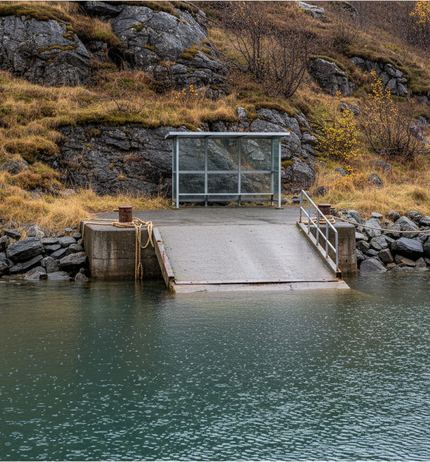
The inner Hardanger
Norway · two bases, ten nights, and boats between them
from $3,620 two sharing two or three parts changed -
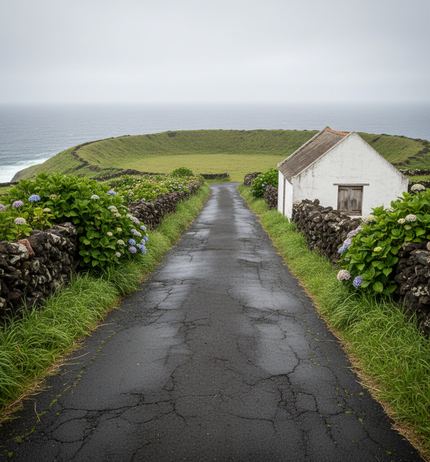
Terceira and the middle islands
Portugal · two bases, twelve nights, no car on one of them
from $3,410 two sharing two or three parts changed -
The Saxon villages of Transylvania
Romania · three bases, a driver, and six of you
from $3,060 two sharing two or three parts changed -
North Jutland and the light
Denmark · two bases, six nights, deep winter
from $2,270 two sharing two or three parts changed -
The Mani and the Taygetos wall
Greece · two bases and a walking week between them
from $2,980 two sharing two or three parts changed -
The Basque interior
Spain · two bases, one of them without a road to it
from $3,240 two sharing two or three parts changed -
The Bohemian uplands
Czechia · three bases, fourteen nights, trains only
from $3,350 two sharing two or three parts changed -
The Langhe and the high Piedmont
Italy · two bases, twelve nights, harvest weeks only
from $3,720 two sharing two or three parts changed
Ask for this change in writing
Not a cent moves through here. The supplier bills you under its own name, and what this office earns reaches it from that supplier weeks later.